Black AIDS Institute releases 2011 State of AIDS in Black America Report
[http://faithinthebay.com/wp-content/uploads/2011/02/moment_250x270_1.jpg]The Black AIDS Institute ("BAI"), the only national HIV/AIDS think tank focused exclusively on the Black community in the US, today released its 2011 State of AIDS in Black America report, Deciding Moment . 2011 marks the 30t

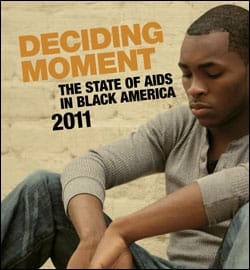
"This report doesn't just lay out the problem. We know what the problems are," says Phill Wilson, President and CEO of the Black AIDS Institute. It provides a scan of the HIV/AIDS landscape and makes recommendations on how to maximize the potential of recent developments in order to finally begin to bring an end to this dreadful disease."
According to the report, implementation of the Patient Protection and Affordable Care Act (ACA) and the National HIV/AIDS Strategy (NHAS) are extremely important to efforts to confront the HIV/AIDS epidemic. But in the current political environment, and as a result of recent changes in the makeup of Congress, both are potentially threatened. "With the National HIV/AIDS Strategy we finally have a roadmap with clear goals, objectives, and metrics to evaluate progress. That's great. But what good is a roadmap if we don't have a mechanism to get to where we want to go?" says Wilson. "The administration, governmental agencies, and Congress need to get behind the implementation of the strategy."
The report calls for implementation and scale up of health care reform. "The elimination of pre-existing conditions, lifting of lifetime and annual spending caps on health coverage, the expansion of access to prescription drugs, allowing people to remain on their parents' health insurance policies are matters of life and death for people living with HIV/AIDS," says Wilson.
Other recommendations in the report include improving the evidence base for action to promote health care access; making sure the Centers for Disease Control (CDC) carefully monitors and reports on HIV prevention spending; taking steps to ensure that new biomedical prevention tools are rapidly assessed, and if effective, expeditiously implemented; and mobilizing Black communities to support a strong and sustained AIDS response that ensures the success of the National HIV/AIDS Strategy in Black communities.
The report concludes with suggestions of how individuals can get involved in fighting the AIDS epidemic on a personal, community and societal level.
"Every day, in ways both large and small, each of us has deciding moments. Moments when we decide to do good, bad, or nothing. Today we are at a collective deciding moment. Except when it comes to HIV/AIDS, there is no difference between doing bad and doing nothing," says Wilson.
Download the full report as a pdf here.
Download the executive summary as a pdf here.